
INNOVATION STATION
Butler University
Butler University engaged with CSO Architects and RJE Business Interiors as the Lacy School of Business prepared to open a new building on campus. One particularly unique area of the building was the Innovation Commons. Butler wanted to create a hub to engage both students and business people.
Butler wanted to attract business people from the greater Indianapolis community with the Innovation Commons, creating a space where they could go as part of their daily work. It was also meant to be a space supporting flexibility and iteration, so that the Innovation Commons could be reimagined on a regular basis to fit the needs of its stakeholders.
Who is Butler University?
Butler University is a private university in Indiana. They offer undergraduate, graduate, and continuing education programs with six academic colleges: Arts, Business, Communication, Education, Liberal Arts and Sciences, and Pharmacy and Health Sciences. They value experiential learning, making sure their students are equipped with hands-on, real-world learning.

33
people engaged
24
hours of observation (6 sites)
29
one-on-one interviews
2
ideation sessions
2
prototyping session
Butler's Challenges & Solutions
During Butler’s Research project, we identified and solved for 8 space challenges they faced in 2018. Here were 3 of their top challenges and the accompanying solutions. If these challenges sound familiar to you and your organization, drop us a line.
On Butler University’s campus, there was a lack of collaborative spaces built to effectively give people what they need. When people were seen collaborating, it was on average in groups of 2-6 people, mostly with peers. Collaboration frequently involved both technology and analog tools; heavily relying on face-to-face communication. People wanted separation between collaboration areas so they didn’t distract others while meeting and could maintain some privacy.
Upon co-creating solution prototypes with stakeholders, DORIS learned that most envisioned three distinct types of breakout rooms: one resembling a living room, one resembling a conference room, and a space for focusing alone. People valued variety and options for the breakout rooms, though all of them would have technology integrated, such as screens, outlets, Wifi, and whiteboard space.
One of the primary concerns was attracting not just students, but also business professionals to the space. In order to do this, people expressed the need for clear expectations and a convenient, centrally located space containing resources they needed.

In order to align on best practices and behaviors, stakeholders agreed common expectations would be important in the shared space. People wanted rules of engagement for the Innovation Commons in order to keep the space feeling professional, fresh, and clean. Stakeholders decided that rules of engagement should be easily accessible and visible within the space. People wanted clear guidelines for what is expected to reset the room. Additionally, while people wanted to be able to bring in food and drink, they still wanted everyone to clean up after themselves.
Both students and professionals expressed the need for more opportunities to get to know each other in frequent, casual settings that emphasized knowledge sharing and fostered close relationships; a space was needed for this. Everyone liked the idea of having more opportunities to form relationships between recent graduates and soon-to-be graduates. Professionals also wanted to share their knowledge and passions with students, and use students as a resource to get feedback on their own business or products.
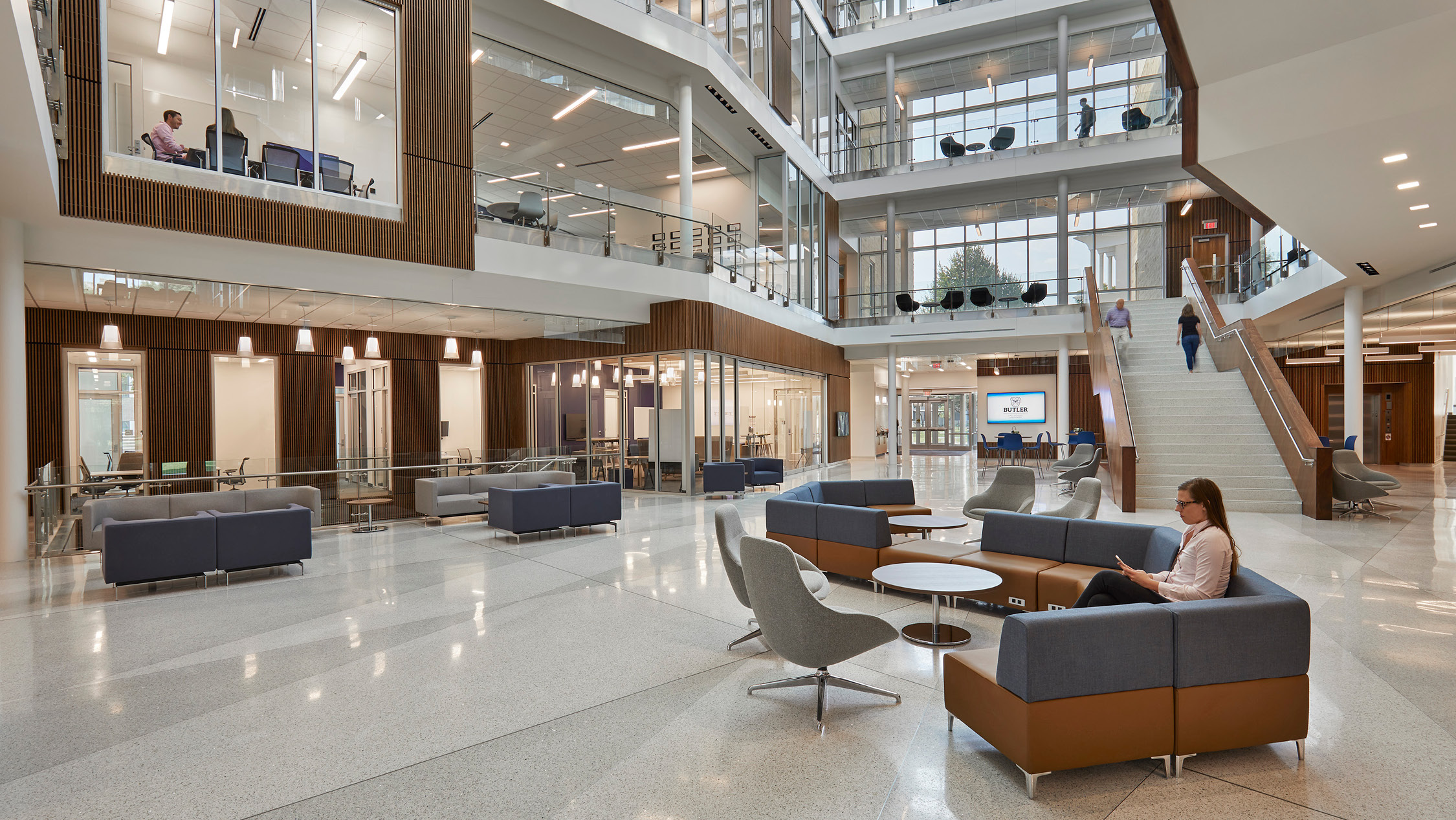
When DORIS hosted ideation and prototyping sessions with stakeholders, it was clear that business people and students alike believed that the Innovation Commons should be used to host events and programming that bring the student body and Indianapolis community together. In fact, stakeholders wanted to be able to attend or host events in the main area of the Innovation Commons. Additionally, the ability to record or livestream events was pitched as a way to further integrate technology and make programming more accessible. Building on that idea, some professionals even wanted to be able to reserve or rent the main area of the Innovation Commons in order to host events targeted at alumni or current students.
prototyping
Interesting Insight
DORIS collaborated with RJE Business Interiors to offer stakeholders the chance to prototype with actual furniture pieces.
Engaging Prototyping Sessions
Two prototyping sessions were facilitated by DORIS, engaging Butler students and business professionals, fostering a co-creation process.
Stakeholders utilized furniture, tape outlines on the floor, teamwork, and creativity to construct full-sized prototypes, enabling direct testing of functionality and flexibility in the space. These sessions provided valuable insights into stakeholder preferences and needs.

Copyright 2026 DORIS Research - Privacy Policy